The leap from managing a single mobile retail store to running a multi-location chain or hybrid wholesale operation is where many electronics merchants encounter severe friction. In a single storefront, an owner can walk the floor, visually verify the safe, and approve discounts on the fly. But the moment inventory disperses across three, five, or ten physical locations—or branches begin fulfilling bulk orders for local sub-dealers—informal oversight collapses.
The stakes in mobile retail are unforgiving. Unlike apparel or general merchandise, smartphones represent high-ticket inventory with short depreciation curves and razor-thin gross margins. In fact, retail research from Omdia underscores that open-channel smartphone sales operate on tight hardware spreads where accessory attach rates and services carry a disproportionate share of net profit. In an environment where device carrying costs and hardware depreciation can erase 10% to 15% of a phone's wholesale value within months, a single lost handset during a branch transfer or an unapproved wholesale discount can swallow a store's weekly profit margin.
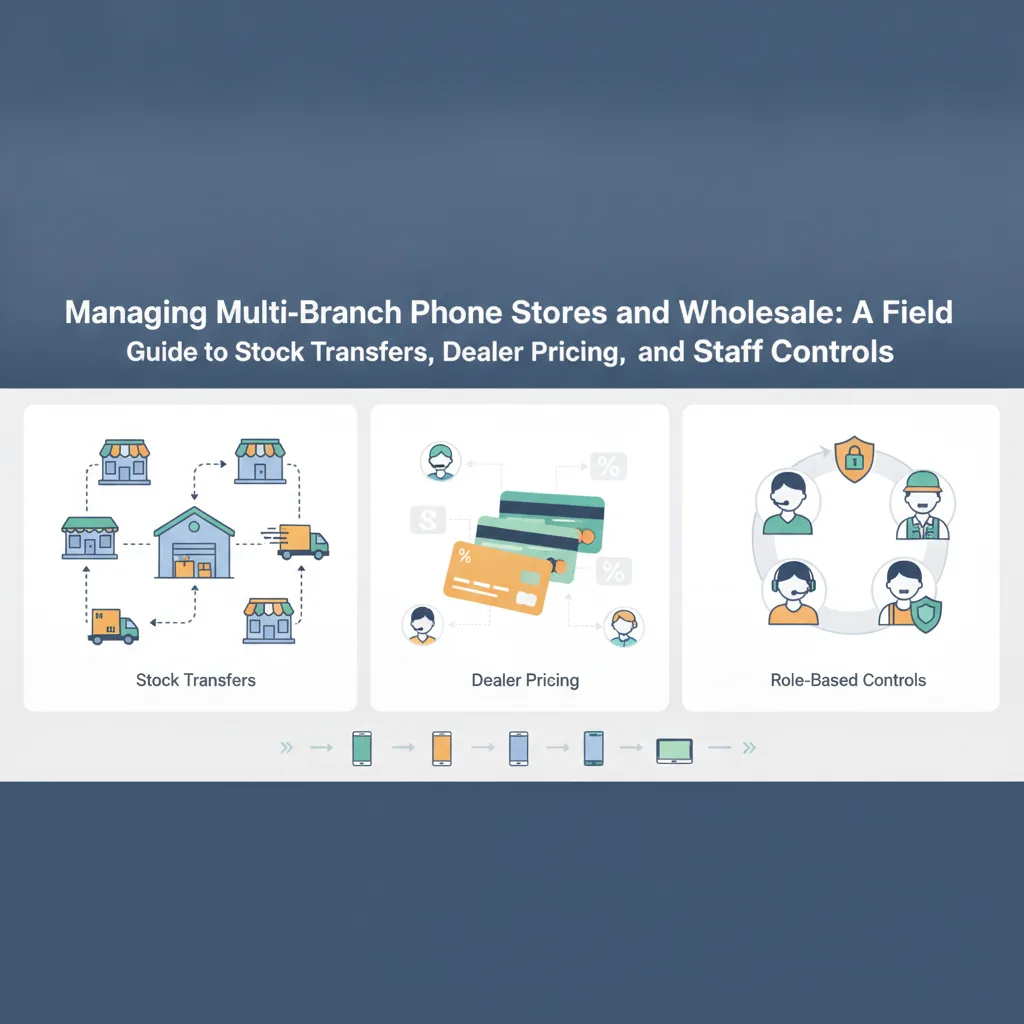
Running a scalable multi-branch or distribution network requires turning loose operational habits into hardened, repeatable systems. Here is a practical field guide to managing inter-branch transfers, tier-based dealer pricing, cross-branch staff permissions, and centralized reporting.
The Anatomy of Clean Inter-Branch Stock Transfers
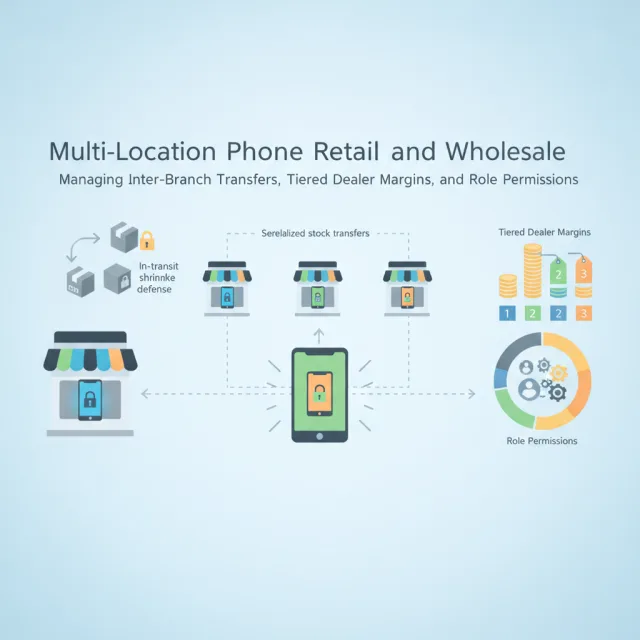
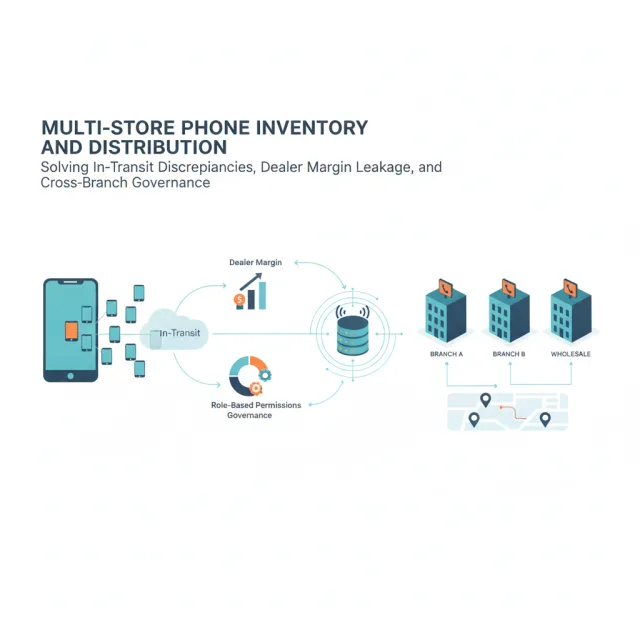
The most common point of inventory shrinkage in multi-store mobile retail is not shoplifting; it is the "in-transit" black hole. When Branch A sends ten units of a popular flagship device to Branch B to meet weekend demand, a standard quantity-based ledger simply logs minus ten in Branch A and plus ten in Branch B. If one box goes missing during courier transit or an employee sets an unrecorded trade-in into the display case, identifying where the breakdown occurred becomes nearly impossible.
Serialized, IMEI-specific tracking must govern every transfer from origination to receipt. To eliminate discrepancies, implement a mandatory two-step custody protocol:
- Dispatch Verification: A transfer request should never be completed by bulk selection. The dispatching store manager must physically scan the specific primary and secondary IMEIs of each phone leaving the branch. At this moment, the inventory status should change to In Transit—deducted from Branch A's sellable stock, but not yet added to Branch B.
- Intake Verification: When the shipment arrives at Branch B, the receiving staff cannot simply click "Receive All." They must scan every individual device barcode upon unboxing. If the intake scan matches the dispatched IMEIs, the units automatically move into Branch B’s active inventory.
- Instant Discrepancy Flagging: If nine devices are scanned but the manifest lists ten, the system must prevent the receipt from closing cleanly. An alert should notify head office immediately, pinning the discrepancy to a distinct transit batch and two specific employee timestamps.
Treating accessories and replacement parts with the same barcode-driven rigor during transfers ensures that low-profile, high-margin items—like premium charging bricks and display assemblies—do not quietly evaporate between stores.
Structuring Dealer Pricing Without Eroding Retail POS Margins
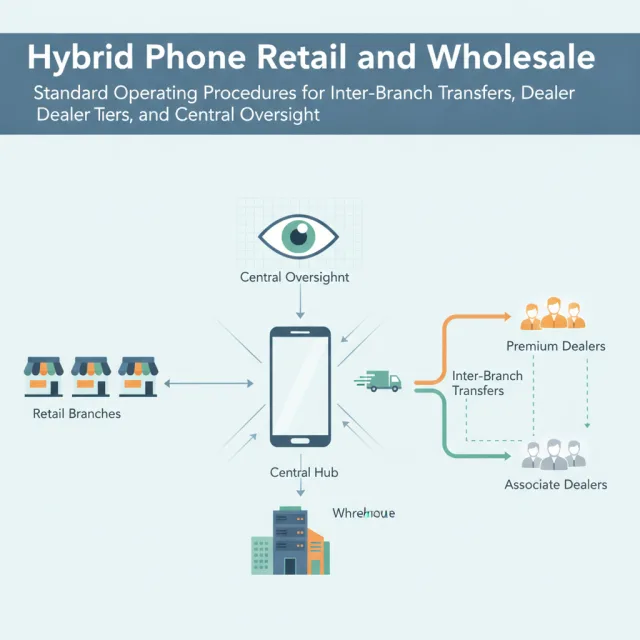
Many successful multi-branch retailers expand by supplying regional sub-dealers, corporate fleet buyers, and independent repair technicians. While wholesale distribution provides higher sales volume, mixing retail and B2B pricing within the same operational infrastructure frequently leads to human error and margin erosion.
When staff members rely on manual price overrides or handwritten notes to give a "dealer discount," two problems routinely emerge: floor sales reps grant wholesale rates to walk-in retail shoppers who negotiate aggressively, or dealers receive arbitrary markdowns that cut beneath your landed cost.
1. Enforce Role-Specific Pricing Tiers
Never rely on open POS discounts for commercial accounts. Instead, configure distinct customer classes with automated price rules:
- Retail Walk-In: Standard retail selling price (MSRP) with strict maximum discount thresholds for sales floor staff.
- Trade/Repair Accounts: Fixed wholesale margins on accessories and spare parts, with standard retail pricing on sealed handsets.
- Tier-1 Sub-Dealers: Contracted cost-plus pricing on bulk handset cartons, conditioned on minimum unit volumes per order.
2. Restrict Cost Visibility
Floor staff at retail branches should see the target selling price and the minimum allowed floor price, but rarely the raw landed purchase cost of the device. Exposing supplier costs to front-line retail staff often encourages unnecessary discounting during customer negotiations. Conversely, your wholesale account managers need visibility into batch costs to negotiate volume orders responsibly.
Establishing Cross-Branch Staff Roles and Approval Gates
As your retail footprint grows, maintaining internal security requires a strict model of least-privilege access. A cashier at an outlying suburban branch does not need access to the financial performance of your flagship downtown store, nor should they have the authority to alter master inventory records.
To keep multi-store operations secure, segment your staff permissions across four critical control gates:
- Transfer Initiation vs. Approval: Allow branch sales associates to generate stock transfer requests when a local customer wants a model housed at another store. However, reserve transfer approval and final dispatch for the branch manager or centralized inventory controller.
- Price Overrides and Returns: Restrict custom price adjustments to senior branch staff. Require managerial sign-off for device returns, refund processing, or warranty swaps to avoid phantom return fraud.
- Cash Drawer Audits and Expense Logging: Cashiers should be locked to their own register sessions. Petty cash disbursements (courier fees, branch cleaning supplies) must require a logged expense reason and manager validation before the drawer reconciles at shift end.
- Mobile Administrative Approvals: Business owners cannot be physically present at every branch counter. Having an administrative mobile app that pushes real-time approval requests for anomalous discounts, inter-branch stock transfers, or high-value returns allows owners to maintain chain-wide control without bottlenecking sales floor velocity.
Consolidated Reporting: Rebalancing Stock and Protecting Working Capital
Operating multiple branches without consolidated analytics leads to one location turning away buyers due to stockouts while another branch sits on aging devices tying up working capital. Periodic physical inventory counts are helpful, but real-time consolidated reporting is what keeps inventory productive.
“In mobile retail, dead stock does not merely occupy shelf space; it silently depreciates every single week an OEM prepares to announce its next-generation chipset.”
To run a lean distribution or retail network, monitor three consolidated reports weekly:
Device Aging by Branch
Generate a centralized report listing all serialized handsets sorted by intake date. If Branch C has held six units of an unlocked premium device for more than 45 days while Branch A turns over that model every 72 hours, do not place a new purchase order with your distributor. Route an internal stock transfer from Branch C to Branch A immediately to liberate trapped capital.
Gross Margin per Square Foot / Location
Gross turnover can mask underlying branch unprofitability. A store generating $80,000 in monthly handset revenue at an average margin of 4% might generate less gross profit than a boutique repair-focused location producing $30,000 at a 35% margin across accessories and screen replacements. Centralized P&L reporting allows you to allocate marketing budgets and inventory allocations where net yields are highest.
Discrepancy and Return Ratios
Track return rates and inventory write-offs across individual branches and employees. If one branch exhibits an abnormal rate of cancelled invoices or defective return claims compared to your chain's benchmark, your management team can immediately audit that location's intake and diagnostic procedures.
The Multi-Branch Operational Checklist
Before expanding into your next retail location or opening wholesale order books, ensure your store network enforces these seven operational fundamentals:
- [ ] Every handset transfer requires an IMEI dispatch scan and a matching recipient scan before clearing the transit ledger.
- [ ] Wholesale dealer accounts are governed by automated pricing tiers, not ad-hoc staff discounts.
- [ ] Front-line retail cashiers are restricted from viewing chain-wide inventory valuation and landed supplier costs.
- [ ] High-value returns, inventory adjustments, and discount overrides require manager-level authentication.
- [ ] Branch stock rebalancing protocols trigger automatically for devices aged past 30 days in low-velocity stores.
- [ ] Centralized reporting separates device hardware margins from high-yield accessory and repair revenue streams.
- [ ] Inter-branch couriers carry serialized manifests with signed proof of handover.
Unifying Multi-Branch Operations with iFoxPro
Managing the operational complexity of a multi-store phone chain or distribution hub becomes straightforward when your software is specifically engineered for serialized mobile retail. Generic point-of-sale systems built for supermarkets or standard boutiques lack the structural ability to track dual-IMEI devices, coordinate inter-branch stock movements, and segment wholesale tiers.
This is where iFoxPro provides an end-to-end operational backbone. Built specifically for mobile phone shops, multi-branch retail chains, wholesalers, and repair centers, iFoxPro tracks devices from purchase to sale across dual IMEIs (IMEI 1 and IMEI 2) alongside barcode-managed accessories and spare parts.
With iFoxPro's centralized multi-branch control, you can initiate and track stock transfers between locations with zero blind spots, supported by consolidated reporting that brings total business visibility to a single screen. Owners can run multi-location chains using the Business plan (supporting up to 5 branches and 15 users at $79/month) or scale without limits on the custom-priced Enterprise plan, which provides unlimited branches, unlimited users, and direct API access.
Crucially, iFoxPro bridges the gap between store floor and executive oversight. The dedicated owner mobile app for Android and iOS features an integrated IMEI camera scanner, real-time business dashboards, smart alerts for low stock or suspicious activity, and one-tap remote approvals for transfers, discounts, expenses, and returns. Combined with role-based permissions, an integrated repair module, and a dedicated, live-synced e-commerce website included on every plan, the platform allows you to scale from a single counter to an expansive retail and wholesale network without sacrificing control.
Scale Your Network with Discipline
Expanding your mobile retail footprint should multiply your profits, not your operational headaches. By replacing verbal agreements with barcode-verified transfers, hardcoding dealer pricing tiers, and establishing clear role-based boundaries, you protect your margins at the point of sale. Treat inventory visibility and serialized control as the foundation of your business, and your multi-branch network will scale smoothly and sustainably.