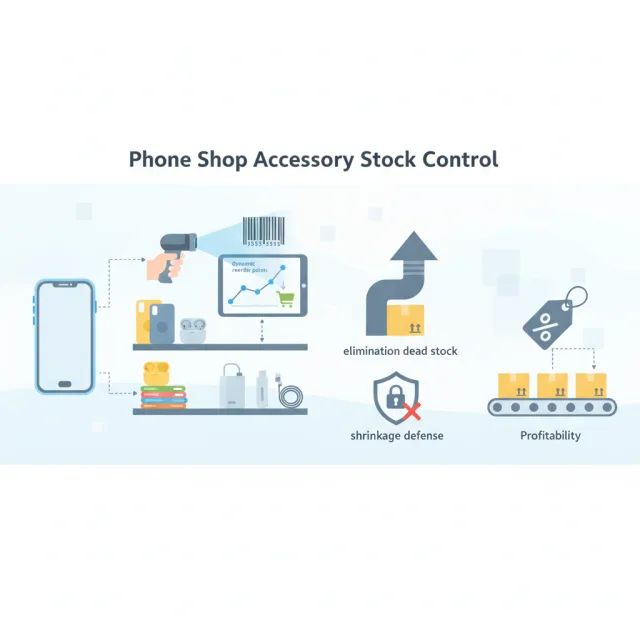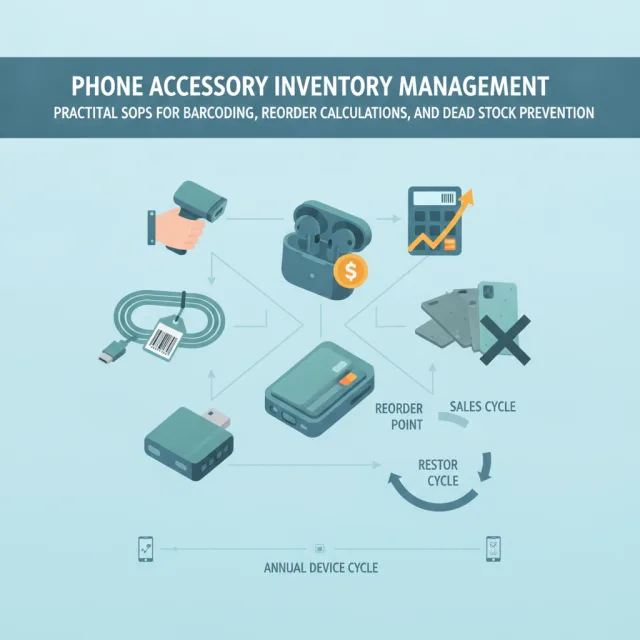
In mobile retail, smartphones bring customers through the door, but accessories pay the shop's rent. While brand-new flagship devices often generate razor-thin gross margins below 5%, auxiliary merchandise—screen protectors, braided fast-charging cables, magnetic car mounts, and protective cases—routinely delivers gross margins between 40% and 70%. Yet behind those healthy margins lies an operational hazard: accessories are small, easily pocketed, bought in mixed bulk shipments, and tightly tethered to rapid smartphone release cycles.
Left unmanaged, an accessory wall quickly deteriorates into a disorganized tangle of unbarcoded items, mismatched ledger counts, and peg hooks full of covers for models nobody buys anymore. According to retail industry research, wireless accessories and electronics suffer from shrinkage rates well above the standard retail average, fueled by a mix of shoplifting, internal theft, and sloppy manual ringing at the point of sale. Regaining control requires a systematic approach to stock architecture, disciplined receiving, and data-backed purchasing.
1. Build a Standard Barcode and SKU Architecture
The root cause of accessory stock discrepancies almost always starts at receiving. When a shop receives 300 phone cases from a wholesale market or regional distributor, half of them arrive in generic clear polybags without scannable EAN or UPC barcodes. The remaining half carry supplier stickers that change with every batch.
When staff cannot scan an item at checkout, they inevitably resort to "speed-ringing"—selecting a generic catch-all button like "Generic Case $15" or scanning whichever nearby package works. In a matter of weeks, your physical shelves bear zero resemblance to your software records.
Designing a Human-Readable SKU Format
To eliminate ambiguity, establish an internal Stock Keeping Unit (SKU) formula before inventory ever reaches the sales floor. A structured SKU structure lets any technician or sales associate identify the exact item at a glance:
[Category]-[Brand/Model]-[Type]-[Color/Variant]
Example:CS-IP15P-MAG-CLR(Case, iPhone 15 Pro, MagSafe Compatible, Clear)
Example:CB-UNIV-C2C-2M(Cable, Universal, Type-C to Type-C, 2-Meter)
Receiving Protocol: Label at the Door
Every single accessory box must undergo a mandatory intake checkpoint:
- Verify against the vendor invoice: Never assume the carton contains the 50 screen protectors listed on the packing slip. Count the pieces.
- Print internal barcode labels immediately: Using an inexpensive direct thermal barcode printer, print barcode labels matching your internal SKU format and affix them directly over generic vendor packaging.
- Enforce a strict "No Scan, No Sale" rule: Remove all generic price lookup buttons from your point-of-sale terminal. If an item cannot be scanned, the cashier must flag it for relabeling rather than guessing a price code.
2. Calculate Dynamic Reorder Points to Prevent Dead Stock
Phone accessories fall into two distinct operational categories, each demanding a different purchasing strategy:
- Universal evergreen accessories: 30W and 65W GaN wall chargers, universal USB-C cables, power banks, and earphone adapters. These items carry steady, predictable demand month after month.
- Device-specific perishable accessories: Cases, camera lens rings, and tempered glass tailored to a single smartphone footprint. These have an aggressive sales curve that peaks during the device's first 90 to 120 days on the market and tapers steeply downward.
Relying on intuition leads to over-ordering device-specific stock (turning cash into unsellable plastic) and running out of fast-selling universal cables. Instead, apply the classic inventory replenishment formula:
Reorder Point (ROP) = (Average Daily Sales × Supplier Lead Time) + Safety Stock
Worked Example: Universal 30W GaN Wall Adapter
- Average Daily Sales: 4 units sold per day.
- Supplier Lead Time: 5 business days for your distributor to deliver replenishment.
- Safety Stock: 6 units (buffer to cover unexpected demand surges or a 2-day delivery delay).
- Calculation: (4 × 5) + 6 = 26 units.
The moment physical inventory dips to 26 units, your reorder trigger fires automatically. You order up to your maximum storage capacity without tying up excess working capital.
Managing the Perishable Device Curve
For model-specific cases, cut your safety stock buffer in half once the device has been on the market for more than six months. When rumors of the next annual hardware release emerge, stop ordering model-specific fashion cases altogether, limiting restocks solely to baseline clear and black shockproof units.
3. Implement Multi-Tier Shrinkage Defenses
Retail shrinkage represents an annual loss exceeding $100 billion globally, with employee theft and shoplifting accounting for the lion's share. Because accessories lack serial numbers or IMEI tracking, they are prime candidates for both customer pocketing and internal "sweethearting" (employees handing free cords or cases to friends).
Securing your accessories requires practical physical and procedural controls working together:
- Replace Annual Audits with Weekly Cycle Counts: Waiting for an annual stocktake ensures that missing stock goes unnoticed until write-offs become catastrophic. Adopt rotating cycle counts: pick one display peg or product category every morning (e.g., Tuesday: audio adapters; Wednesday: premium cases) and count 10 to 15 SKUs against your software balance. Any discrepancy can be investigated within 24 hours of occurrence.
- Implement Merchandising Thresholds: High-ticket accessories (such as ANC earbuds, premium MagSafe power banks, or gimbal stabilizers) should never sit unsecured on open sales floor hooks. Use locking peg hooks, security wraps, or display an empty demo package while keeping live stock behind the service counter.
- Audit Permissions and Price Overrides: Restrict cashier permissions. Cashiers should not have the administrative authority to issue manual line-item discounts, edit selling prices, or process item returns without a manager PIN or mobile sign-off.
4. The Dead Stock Liquidation Playbook
No matter how disciplined your forecasting is, shifts in consumer preferences will eventually leave you with aged inventory. If a phone model is discontinued, its custom-fit cases become dead capital taking up valuable retail real estate.
The goal is to recover landed cost as quickly as possible before the stock's market value drops to zero:
- The Point-of-Sale Hardware Bundle: When closing a refurbished or new handset sale, train staff to pitch accessory bundles. Offering an older-generation case and tempered glass protector at a steep 50% discount feels like high value to the customer while successfully clearing obsolete stock.
- Repair Desk Cross-Selling: When a customer collects a phone after a screen replacement, bundle a heavy-duty protector or case into the repair invoice at near-cost as "warranty insurance."
- Strategic Wholesale Batching: If stock sits untouched for more than 180 days, bundle it into mixed lots and liquidate it to secondary repair shops, online liquidators, or discount stalls. Recouping 30% of wholesale cost today is vastly superior to paying holding costs on unsellable items for another year.
How iFoxPro Unifies Phone Shop Inventory and Accessories
Managing IMEI-serialized smartphones alongside tens of thousands of bulk, non-serialized accessories is a structural challenge that generic retail POS systems are not designed to handle. A dedicated platform like iFoxPro bridges this divide directly inside an all-in-one cloud management workspace built specifically for mobile retail.
iFoxPro pairs complete IMEI tracking for devices with a barcode-driven accessory engine. Shop managers can generate and print barcode labels, track accessories across multiple branches, and set automated low-stock smart alerts that notify operators before bestsellers run out. Built-in employee role permissions prevent unauthorized discounts or price manipulations at the cash drawer, while the companion mobile app for iOS and Android gives store owners a live business dashboard with one-tap approvals for stock transfers, expenses, and returns.
Furthermore, because every iFoxPro subscription includes a dedicated, ready-made e-commerce website on your own domain with live stock synchronization, your accessory catalog is instantly purchasable online for branch pickup or home delivery—ensuring aged stock gains maximum visibility across both physical and digital sales channels.
Protecting Margin Where It Counts
Smartphone retailers cannot afford to treat accessories as an afterthought. Because handsets operate on razor-thin profits, your accessory displays dictate whether your shop ends the quarter comfortably in the black or scrambling to cover overhead. By enforcing rigorous barcode discipline upon receipt, establishing automated reorder points based on real sales velocity, and conducting relentless cycle counts, you transform your accessory section from an operational leak into a reliable profit engine.