Walk onto almost any mobile retail floor today, and the shift is unmistakable. Shelves are stocked with fewer entry-level budget handsets, showcase displays feature higher-ticket flagships, and customers are asking sharper questions about trade-in values and screen replacements. Retailers are not imagining this squeeze: the global smartphone market is experiencing one of the sharpest pricing bifurcations in mobile history.
For independent retailers, multi-branch operators, and service center owners, this is not merely an abstract supply chain issue discussed in quarterly earnings calls. It directly alters shop floor economics, working capital requirements, floor traffic, and inventory carrying risk. Navigating this environment requires understanding the global forces at play and making decisive adjustments to purchasing, inventory velocity, and service desk operations.
The 2026 Hardware Squeeze: Shrinking Shipments, Rising ASPs
According to analysis from the IDC Worldwide Quarterly Mobile Phone Tracker, global smartphone shipments are projected to contract by 16.7% in 2026, dropping to roughly one billion units. Yet total market value is forecast to climb 6.3% to $613 billion. The engine behind this divergence is a dramatic jump in Average Selling Prices (ASPs), which have surged 27.6% year-over-year to reach an average of $581 per device.
This unusual dynamic—a shrinking unit market that simultaneously generates higher overall revenue—stems largely from the semiconductor supply chain. The explosive global demand for artificial intelligence data infrastructure has monopolized high-bandwidth memory production, sending DRAM and NAND flash memory component costs climbing by triple digits since late 2025. Market intelligence from Counterpoint Research confirms that rising bills of materials (BOM) have disproportionately punished mass-market and sub-$200 devices, where thin margins leave manufacturers unable to absorb cost increases without hiking retail prices.
The smartphone market is no longer driven by sheer unit turnover. It is defined by high-ticket hardware, extended consumer holding periods, and an aggressive pivot toward the premium tier.
As original equipment manufacturers (OEMs) prune unprofitable budget product lines and push consumers toward premium flagships equipped with on-device generative AI chips, independent phone retailers find themselves caught in the middle. The customer who walked in looking for an affordable $180 Android replacement is encountering devices priced at $260 or higher—or discovering that budget tiers have been quietly discontinued.
What Higher ASPs Mean for the Independent Retail Floor
When the acquisition cost of mobile inventory climbs by nearly 30% in a single year, standard retail playbooks break down. Shop owners face four immediate structural challenges:
- Intense working capital pressure: Allocating capital for 50 boxed handsets now requires 25% to 35% more cash outlay than it did two years ago. For independent dealers operating on short-term bank credit or supplier terms, purchasing power is constrained, leaving less liquidity for high-turnover accessories and spare parts.
- Higher capital-at-risk per square foot: A single display showcase containing fifteen premium flagship models can represent $12,000 to $18,000 in wholesale cost. Shrinkage, damage, or sudden carrier price drops carry a far greater financial penalty when concentrated in fewer, high-value serialized units.
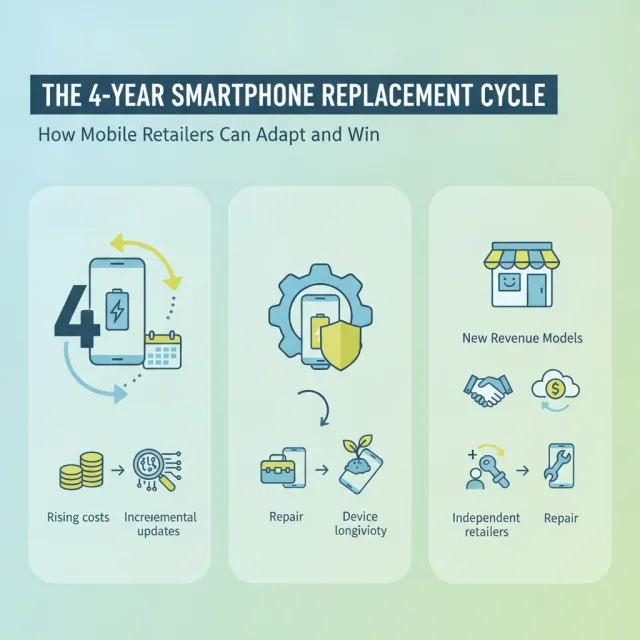
- Slower new-device velocity: Consumers facing steeper price tags are holding their existing devices longer, stretching upgrade cycles toward four years. Those who do purchase expect greater trade-in credit for their old devices to cushion the blow of higher retail pricing.
- Thin primary gross margins: While retail prices have escalated, wholesale margins on brand-new, sealed Tier-1 handsets remain notoriously tight—typically hovering between 3% and 7%. Retailers are taking on significantly higher financial risk for essentially the same absolute dollar profit per box.
Strategic Operational Pivots for Mobile Phone Shops
Thriving during an ASP surge requires recalibrating your store's product mix away from low-margin new box distribution and toward high-margin, circular services. Retailers outperforming the broader market are focusing on five key operational shifts:
1. Compress Serialized Inventory Aging Thresholds
Holding slow-moving new stock has become unaffordable. While a 60-day shelf life was once acceptable for sealed mid-tier handsets, holding an $800 device for 60 days locks up vital cash flow while the device depreciates. Top-performing stores are capping target holding times at 21 to 30 days. If an individual IMEI sits unsold beyond 30 days, it must trigger automated promotional bundling, inter-branch transfers to a faster-moving location, or dealer-to-dealer wholesaling to recover liquidity.
2. Expand Certified Pre-Owned and Refurbished Flagships
When brand-new device prices outpace household budgets, consumers migrate en masse to the secondary market. Buyers who balk at an $1,100 flagship will willingly pay $450 to $600 for a pristine, Grade-A refurbished model from the preceding generation. Pre-owned handsets carry gross margins ranging from 18% to 28%—four to five times the margin of sealed retail units. Establishing strict cosmetic grading standards and transparent warranty policies lets independent stores capture the trade-down demand created by soaring new-device prices.
3. Maximize Bench Velocity in the Service Department
As replacement costs escalate, repairing an existing phone becomes an easy economic choice for consumers. A $140 battery and OLED screen replacement is far more palatable to a customer than absorbing a $700 upgrade. Forward-thinking retailers are expanding their service bays, training technicians on modern display calibration and housing transfers, and optimizing their intake-to-dispatch turnaround times. Service revenue delivers gross margins above 50% while simultaneously generating trade-in leads from customers who ultimately decide against repairing.
4. Enforce Non-Negotiable Accessory Attach Rates
Because unit sales volumes are compressed, extracting maximum margin from every completed transaction is critical. Customers spending top dollar on a new or certified pre-owned smartphone are naturally motivated to protect that investment. Floor staff should be trained on bundled protection packages: tempered glass, high-impact cases, camera lens covers, and authentic high-wattage fast chargers. Achieving a 2.5+ accessory attach rate transforms a break-even handset sale into a profitable customer interaction.
5. Implement Real-Time Cross-Branch Stock Mobility
For multi-branch retail operators, storing redundant safety stock across multiple locations is no longer feasible under high ASPs. Instead of tying up capital by stocking three units of a high-value SKU at every store, operators are utilizing centralized visibility to execute rapid inter-branch stock transfers based on real-time customer demand. If Branch B receives a walk-in request for a 512GB flagship, they should instantly confirm its availability at Branch A and dispatch it immediately, rather than placing an unnecessary order with a distributor.
Action Checklist: Auditing Your Store Against the ASP Surge
- Review inventory capital allocation: Ensure that no single brand or high-ticket model family accounts for more than 35% of total retail working capital.
- Audit shelf age by IMEI: Generate a report of all devices in stock for more than 30 days and apply targeted retail promotions or inter-store transfers to clear them.
- Standardize trade-in valuation tables: Adjust buyback pricing weekly to reflect secondary wholesale movements and prevent overpaying for trade-in inventory.
- Track service turnaround metrics: Measure technician intake-to-bench time, ensuring customer repairs are completed within 24 to 48 hours to maintain high service throughput.
- Monitor accessory margin contributions: Track gross profit percentages generated by protective cases, screen protectors, and power accessories against total store overhead.
Building Operational Resilience with Modern Retail Software
Executing these adjustments manually or on disjointed spreadsheets is nearly impossible when managing hundreds of unique, high-value serial numbers. Successfully navigating a high-ASP, low-volume market requires specialized tooling built for the realities of the mobile phone retail trade.
This is where purpose-built platforms like iFoxPro provide immediate operational control. Cloud-based management software designed specifically for phone shops allows owners to track devices at the granular IMEI level—recording dual IMEIs, tracking exact purchase costs, and monitoring days in stock across every location. When high-ticket devices sit idle, automated alerts notify management to reallocate or discount stock before margins evaporate.
Furthermore, managing the surge in service demand requires an integrated repair and service center module capable of generating job cards, tracking spare parts consumption, and logging technician velocity. Combined with multi-branch stock transfers and live inventory synchronization across physical locations and your integrated web storefront, stores can maintain minimal on-hand stock while serving customer demand across every sales channel.
Conclusion
The global smartphone market is undergoing a permanent structural realignment. As memory supply dynamics and premium hardware architectures continue to push device prices higher through 2026 and into 2027, the traditional retail model of surviving on high-volume, low-margin new box distribution is rapidly closing.
The independent retailers and service operators who will lead this new cycle are those who adapt their business model: treating serialized inventory with strict velocity discipline, expanding their certified refurbished selections, and turning their service desk into a high-margin engine. By adjusting your operational metrics today, you can protect your working capital, expand your bottom-line margins, and turn global supply headwinds into a lasting competitive advantage.