For more than a decade, independent mobile phone retailers and service centers have operated under the thumb of closed manufacturer ecosystems. Independent shops faced restricted component supplies, inflated third-party distribution markups, and aggressive software pairing mechanisms designed to turn third-party screen or battery replacements into customer service headaches. In late 2026, that landscape has fundamentally shifted.
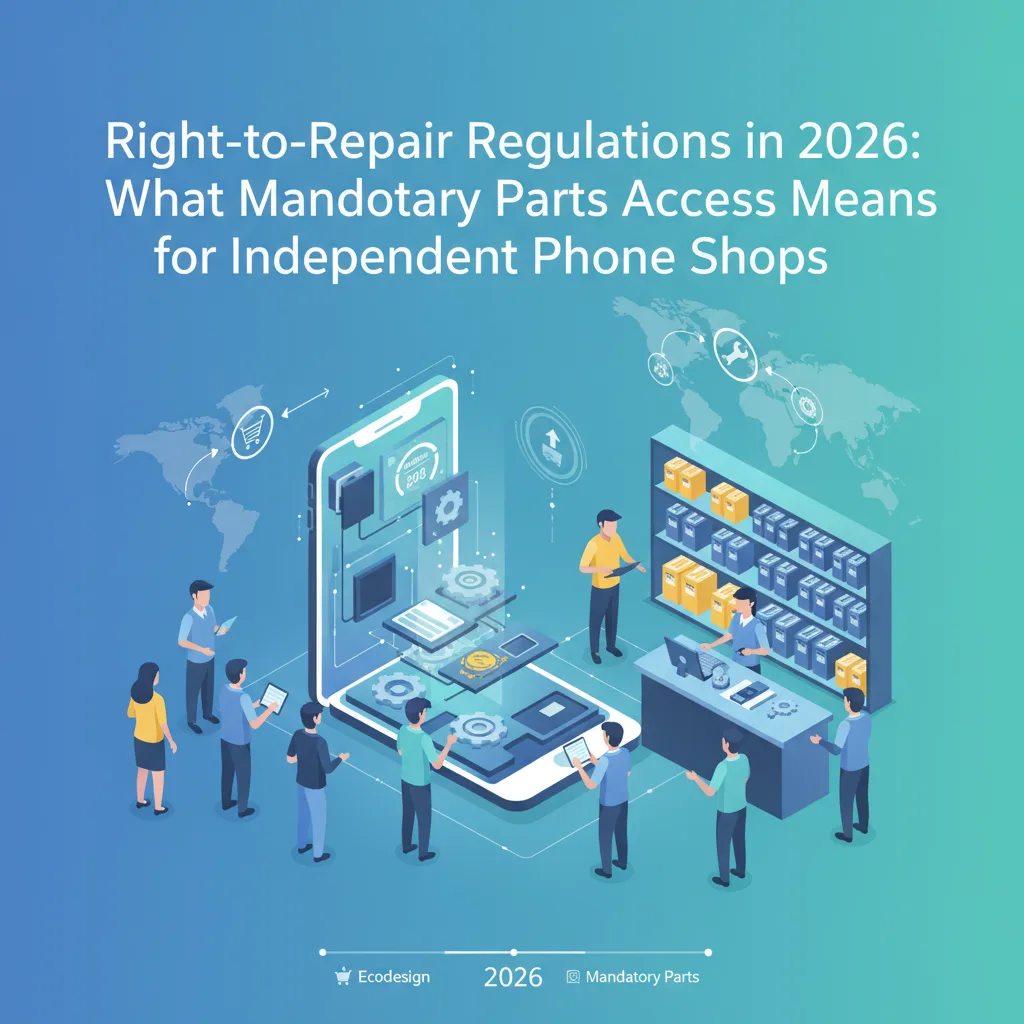
A wave of landmark legislation—spearheaded by the rollout of the European Union’s Right to Repair Directive alongside national transpositions, evolving right-to-repair statutes across major US states, and strict EU Ecodesign smartphone regulations—has moved from policy draft to active enforcement. Device makers are legally required to provide spare parts, repair documentation, and diagnostic access on fair, non-discriminatory terms for up to seven years after a model’s discontinuation. For independent phone shops and multi-branch retail operators worldwide, these regulatory shifts represent the largest operational and commercial opportunity in years—if your business is organized to capture it.
The Regulatory Shift: From Proprietary Moats to Open Workbenches
To understand the commercial reality on the shop floor today, retailers need to look at how two distinct layers of regulation converged over the past eighteen months:
- Mandatory Spare Parts Availability: Under ecodesign and durability mandates, smartphone manufacturers placing devices on major global markets must maintain inventories of critical replacement parts—including displays, batteries, back covers, and camera modules—for seven years post-production, with mandated delivery windows often measured in days rather than months.
- Barriers Against Software Restrictions: Modern right-to-repair frameworks explicitly penalize commercial practices that artificially hinder repair, such as unjustifiable software lockouts or pairing routines that disable device features when an unverified yet functional part is installed.
- Standardized Repairability Indices: In key international markets, smartphones now display standardized repairability ratings (graded A through E) on retail shelf labels and digital listings. Consumers walk into storefronts armed with official data on how easily a handset can be dismantled and serviced.
Because original equipment manufacturers (OEMs) cannot efficiently maintain fragmented global hardware architectures, design decisions made to satisfy strict regional rules ripple across international supply chains. Devices entering the secondary and repair streams are physically and architecturally more serviceable than those produced four years ago.
The Macro Squeeze: Why Repair Demand Is Booming
This legislative breakthrough has arrived at a critical economic inflection point. According to global tracker data from International Data Corporation (IDC), worldwide smartphone average selling prices (ASPs) have surged toward unprecedented highs near $580, driven by escalating component costs and memory price pressures. As entry-level new hardware grows costlier and macroeconomic uncertainty persists, consumers are abandoning the two-year replacement cycle.
When replacing a mid-range or flagship phone costs hundreds of dollars more than it did two years ago, spending $90 to $180 on a genuine battery swap or display refurbishment becomes an obvious financial decision for device owners. Independent shops are no longer just fixing cracked screens for tech hobbyists; they have become the primary line of defense against household inflation for mainstream mobile consumers.
The combination of record-high handset prices and mandated access to OEM-grade components has transformed independent phone repair from a low-margin reactive service into a high-trust, primary revenue channel.
Operational Hurdles: The New Challenges Facing Independent Shops
While the right-to-repair era opens unprecedented access, it also demands professionalization. Independent operators can no longer run repair desks out of paper notebooks, informal messaging threads, and disorganized parts bins. Three specific operational challenges have emerged:
1. Increased Customer Scrutiny and Warranty Expectations
As repair rights become mainstream news, consumers expect service center accountability comparable to an authorized brand flagship. When an independent shop quotes an OEM-grade repair, customers demand serial verification, documented pre-intake testing, and clear warranty terms. If a device malfunctions post-repair, customers expect immediate resolution tied to their original invoice and IMEI record.
2. Parts Inventory Complexity
Having legal access to purchase components does not mean managing inventory is simple. Shops must now stock multiple grades of parts across a wider variety of supported generations—since devices are staying in active circulation for four to six years. Tying up operating capital in slow-moving displays or untested aftermarket batteries without real-time inventory tracking can destroy shop cash flow.
3. Margin Defense Against Transparent Parts Pricing
Because regulations require manufacturers to publish indicative spare-parts pricing on public portals, customers increasingly know the base cost of an original screen or battery. Shops can no longer obscure high part markups; profit margins must instead be earned through diagnostic skill, bench velocity, professional labor, and reliable post-repair warranties.
Playbook: How Mobile Shops Can Capitalize on Right-to-Repair in 2026
Independent retailers and service centers looking to dominate their local catchment areas should systematically audit their intake, bench, and inventory operations using the following framework:
- Formalize Dual-Tier Parts Sourcing: Build direct relationships with legitimate wholesale distributors offering verified OEM service packs alongside certified Tier-1 aftermarket alternatives. Clearly display both options to customers at intake, explaining the difference in warranty duration, price, and expected longevity.
- Implement Serialized Diagnostic Audits at Intake: Always record both IMEI 1 and IMEI 2, physical battery health percentages, sensor functionality, and cosmetic grades before taking custody of any device. Pre-intake testing protects your technicians from pre-existing board faults and prevents unfair liability claims when a device leaves the bench.
- Bind Spare Parts Directly to Service Job Cards: Eliminate parts leakage by ensuring that no technician pulls a display or charging port from storage without scanning it directly to an active job card. Every consumed component must automatically decrement inventory and tie to the device’s unique IMEI.
- Offer Digital Repair Tracking to Build Trust: Modern consumers expect transparency. Instead of forcing clients to call your shop for updates, provide automated SMS or online self-service portals where customers can enter their job number or IMEI to check whether their device is in queue, on the bench, awaiting parts, or ready for pickup.
- Leverage Repairs to Feed Buyback and Refurbished Sales: Devices brought in with uneconomical repair costs (such as catastrophic liquid damage across motherboard and OLED) are prime intake opportunities. Offer fair trade-in credit toward a certified pre-owned device in your showcase, harvesting salvageable parts where legally permissible or responsibly recycling the unit.
Streamlining Service Operations with iFoxPro
Managing the operational demands of the modern repair ecosystem requires purpose-built infrastructure. Generic retail cash registers cannot handle serialized part tracking, technician accountability, or long-term warranty histories.
Designed specifically for mobile phone retail and service centers, iFoxPro provides an integrated repair and service center module that keeps your workshop running efficiently. Store managers can generate detailed digital job cards, assign specific technicians to work orders, and allocate spare parts directly from stock using barcode scanning. Because iFoxPro is built around complete IMEI-based phone management, every repair, intake check, and warranty claim is permanently linked to the handset’s unique IMEI history across both SIM slots.
Furthermore, every iFoxPro plan includes a dedicated e-commerce website on your own shop domain. This allows customers to log into their personal account and track repair progress or verify their active serialized warranty directly from their phone. Whether operating a single neighborhood workbench or coordinating inter-branch parts transfers across a multi-location chain, shop owners can monitor bench velocity, track parts usage, and approve repair discounts in real time through the iFoxPro mobile app for iOS and Android.
Conclusion
The right-to-repair movement has permanently leveled the playing field between multi-billion-dollar phone manufacturers and local repair workshops. However, regulatory access alone does not guarantee business success. As customers demand greater transparency, faster turnaround times, and professional warranty support, independent mobile retailers that modernize their workflows, professionalize their spare-parts management, and digitize their customer communication will capture the lion's share of this rapidly expanding market.